The artworks visible on and around the Eucalypt Lawn are part of an
exhibition titled Trees: As above, So Below, created by members of
Networks Australia, a group of primarily Canberra based visual artists
who have exhibited extensively nationally and Internationally,
addressing a variety of issues, social, political and environmental.
In
this instance inspired by the work of the ANBG and a slew of recent
books on the subject of trees, 1 the artists focus on the broader and
often overlooked if not hidden aspects of trees to expand perceptions
beyond the visible structure to root systems and canopies and various
interdependences and interactions with other life forms vital in
maintaining a healthy eco-system.
Bev Moxon
Deborah Faeyrglenn
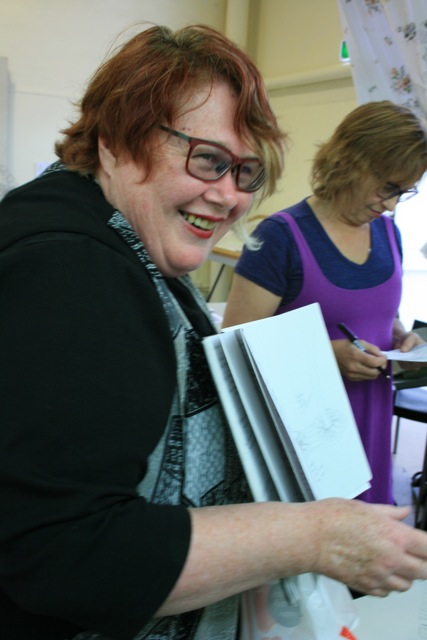
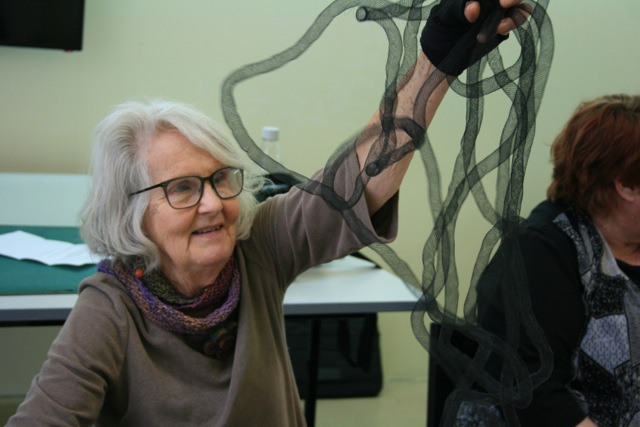
Members discussing Trees: As above, So Below exhibition works
Two links with a talk and an interview with Dr Suzanne Simard supplied by Deborah Faeyrglenn about Tress and their ways of communicating with each other.
"A forest is much more than what you see," says
ecologist Suzanne Simard. Her 30 years of research in Canadian forests
have led to an astounding discovery -- trees talk, often and over vast
distances. Learn more about the harmonious yet complicated social lives
of trees and prepare to see the natural world with new eyes.
Interview with Yale Environment 360 and Dr Suzanne Simard
Exploring How and Why Trees ‘Talk’ to Each Other
Ecologist Suzanne Simard has shown how trees use a network of
soil fungi to communicate their needs and aid neighboring plants. Now
she’s warning that threats like clear-cutting and climate change could
disrupt these critical networks.
Two decades ago, while researching her doctoral thesis, ecologist
Suzanne Simard discovered that trees communicate their needs and send
each other nutrients via a network of latticed fungi buried in the soil —
in other words, she found, they “talk” to each other. Since then,
Simard, now at the University of British Columbia, has pioneered further
research into how trees converse, including how these fungal filigrees
help trees send warning signals about environmental change, search for
kin, and transfer their nutrients to neighboring plants before they die.
Beiler et al 2010
A diagram of a fungal network that links a group of trees, showing the presence of highly connected “mother trees.”
By using phrases like “forest wisdom” and “mother trees” when she
speaks about this elaborate system, which she compares to neural
networks in human brains,
Simard’s work has helped change how scientists define interactions
between plants. “A forest is a cooperative system,” she said in an
interview with Yale Environment 360. “To me, using the language
of ‘communication’ made more sense because we were looking at not just
resource transfers, but things like defense signaling and kin
recognition signaling. We as human beings can relate to this better. If
we can relate to it, then we’re going to care about it more. If we care
about it more, then we’re going to do a better job of stewarding our
landscapes.”
Simard is now focused on understanding how these vital communication
networks could be disrupted by environmental threats, such as climate
change, pine beetle infestations, and logging. “These networks will go
on,” she said. “Whether they’re beneficial to native plant species, or
exotics, or invader weeds and so on, that remains to be seen.”
Today I bought this book at the Book Grocer at the Majura Shops for $10.00. It has beautiful images in it and even has one of Crown Shyness. These images seem to be popping up every where for me at the moment.
The Phenomenon Of “Crown Shyness” Where Trees Avoid Touching By Christopher Jobson
Crown shyness
is a naturally occurring phenomenon in some tree species where the
upper most branches in a forest canopy avoid touching one another. The
visual effect is striking as it creates clearly defined borders akin to
cracks or rivers in the sky when viewed from below. Read full article
As the Networks group is looking at Trees as a theme at the moment, there is a very interesting interview with Lesley Richmond on Textileartist.org Textileartist.org has interesting interviews and information for contemporary textile artists.
Lesley Richmond was born in Cornwall, England. Lesley now lives in Vancouver, BC, Canada.
Lesley Richmond, Winter Series Moonlight Mandala
84cm x 140cm image from artists Website